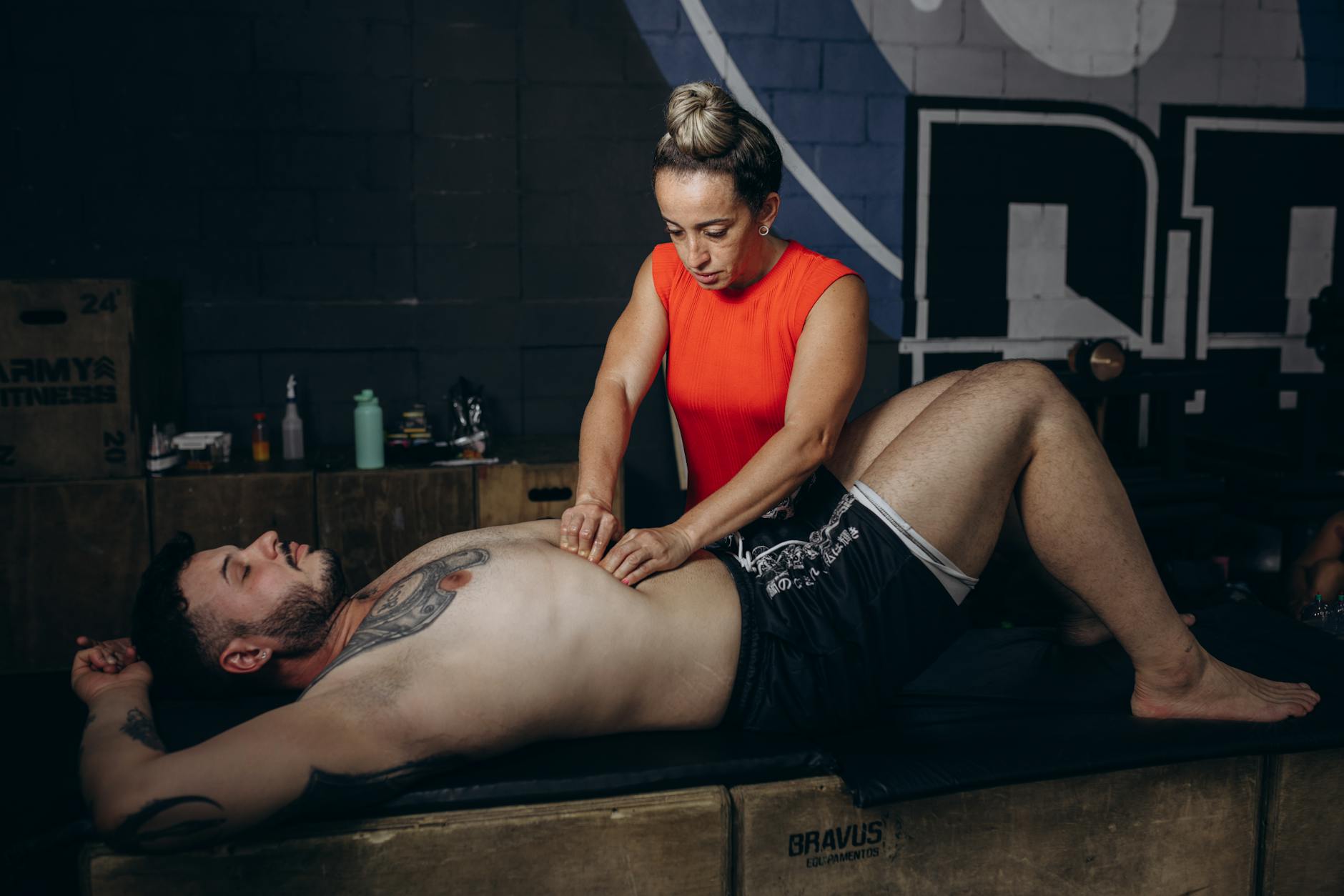
“No days off” sounds motivating. It’s also a fast track to injury and zero gains.
Muscles grow when you rest, not when you lift.
Here’s how to optimize recovery for actual results.
How Muscle Growth Works
Quick science lesson:
- You lift weights — Muscle fibers experience micro-tears
- You rest — Body repairs tears, building fibers back stronger
- You lift again — Fibers tear again, cycle repeats
- Result — Progressively stronger, bigger muscles
Skip step 2 and step 3 is lifting with damaged muscles. No progress. Injury risk.
Recovery Time by Muscle Group
Not all muscles recover equally.
| Muscle Group | Recovery Time | Train Frequency |
|---|---|---|
| Back | 48-72 hours | 2x per week |
| Chest | 48-72 hours | 2x per week |
| Legs (quads, hams, glutes) | 72-96 hours | 1.5-2x per week |
| Shoulders | 48-72 hours | 2-3x per week |
| Biceps | 48-72 hours | 2-3x per week |
| Triceps | 48-72 hours | 2-3x per week |
| Abs | 24-48 hours | 3-4x per week |
| Calves | 24-48 hours | 3-4x per week |
Why legs need more: Larger muscles with more fibers = more repair needed.
Why abs need less: High endurance fibers, used to frequent activity.
The 48-72 Hour Rule
The general rule: Wait 48-72 hours before training the same muscle group again.
Monday: Chest and triceps Wednesday: Back and biceps Friday: Legs
Each muscle gets trained once, then rests before the next session.
Factors That Affect Recovery
1. Training Intensity
Heavier weights = more damage = longer recovery
A max-effort deadlift session needs more recovery than light accessory work.
2. Training Volume
More sets = more fatigue = longer recovery
20 sets of chest needs more recovery than 10 sets.
3. Experience Level
- Beginners: Recover faster (less damage created)
- Intermediate: 48-72 hours typically
- Advanced: May need more due to intensity
4. Age
20-year-olds recover faster than 40-year-olds. Biology.
5. Sleep
Poor sleep = poor recovery. Period. This is non-negotiable.
6. Nutrition
Not enough protein = not enough building blocks for repair.
Minimum: 0.7g protein per pound of bodyweight.
7. Stress
Mental stress = cortisol = impaired recovery.
Signs You’re Not Recovering Enough
Performance signs:
- Weights feel heavier than last week
- Can’t hit the same reps
- Strength decreasing over time
- Workouts feel harder than they should
Physical signs:
- Persistent soreness (more than 48 hours)
- Feeling weak/fatigued
- Nagging pains that won’t go away
- Getting sick frequently
Mental signs:
- Dreading workouts you used to enjoy
- Motivation dropping
- Sleep problems
- Irritability
If you see multiple signs: Take more rest days.
Signs You’re Resting Too Much
Performance signs:
- Not getting stronger week to week
- Workouts feel too easy
- No soreness ever
Mental signs:
- Feeling restless on rest days
- Workouts feel like you’re just going through motions
The balance: Enough stress to stimulate growth, enough rest to allow it.
The Right Split for Recovery
3-Day Full Body (Beginner)
Best recovery: Each muscle trained 3x/week with 48+ hours between
Mon: Full body Wed: Full body Fri: Full body
4-Day Upper/Lower
Good recovery: Each muscle trained 2x/week with 72 hours between
Mon: Upper Tue: Lower Thu: Upper Fri: Lower
6-Day Push/Pull/Legs
Tight recovery: Each muscle 2x/week with minimal rest
Mon: Push Tue: Pull Wed: Legs Thu: Push Fri: Pull Sat: Legs
Requires good sleep and nutrition. Not for beginners.
Active Recovery
Rest days don’t mean do nothing.
Good active recovery:
- Walking
- Light yoga
- Swimming (easy)
- Mobility work
- Light cycling
Bad active recovery:
- “Light” lifting (still stresses muscles)
- Intense cardio
- Sports that use the same muscles
Sleep and Recovery
This cannot be overstated.
During deep sleep:
- Growth hormone releases
- Muscle protein synthesis peaks
- Cortisol drops
Sleep recommendations:
- Minimum: 7 hours
- Optimal: 8-9 hours
- After intense training: 9+ hours
One night of bad sleep won’t kill you. Chronic sleep deprivation kills gains.
Tracking Recovery
How do you know if you’re recovered enough?
Option 1: Listen to your body
Still sore? Feel weak? Rest another day.
Option 2: Performance tracking
Are your lifts going up over time? You’re recovered enough.
Option 3: Use a tracker
GymCoachAI factors in recovery when planning workouts. Won’t program muscles that haven’t had enough rest.
FAQ
How long should I rest between sets? Different question. Between sets: 2-3 minutes for strength, 60-90 seconds for hypertrophy.
Can I train a muscle that’s still sore? Light soreness is okay. Significant soreness means rest more.
Is soreness a sign of a good workout? Not necessarily. You can have an effective workout without soreness.
Do I need supplements for recovery? Sleep, protein, and water beat any supplement. Get those first.
Should I stretch on rest days? Yes. Light stretching and mobility work support recovery.
Is 24 hours enough rest for any muscle? Only for abs and calves, and only if training wasn’t intense.
Related reads:
- AI Workout Apps That Build Muscle — apps that program recovery
- Rest Days Recovery Guide — what to do on rest days
- Why Your Gym Results Suck — common mistakes
— Dolce
Comments
Comments powered by Giscus. Sign in with GitHub to comment.