The fitness industry is a $100 billion business built on making simple things complicated.
Keto. Paleo. Clean eating. Superfoods. Metabolic confusion. Hormone optimization.
Here’s what nobody wants to tell you:
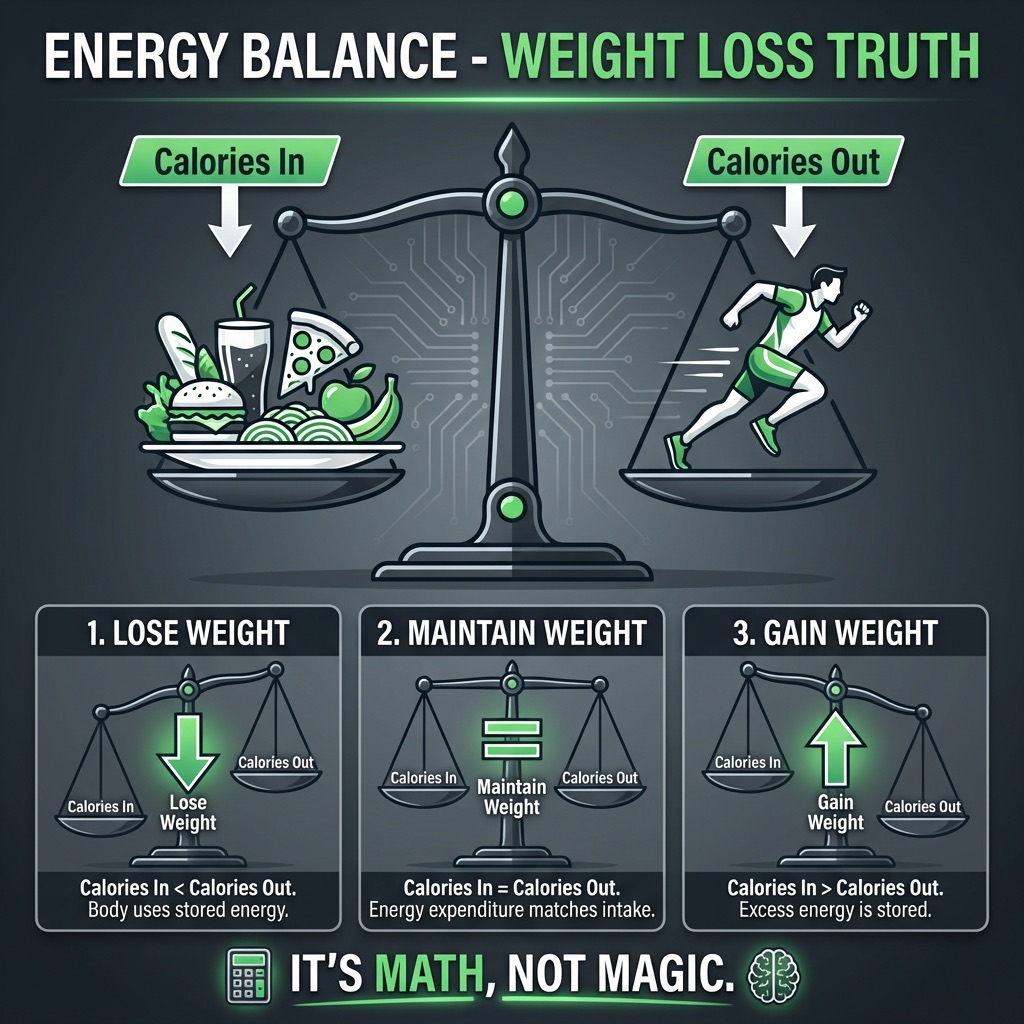
Weight loss is math.
Eat less energy than you burn = lose weight. Eat more energy than you burn = gain weight.
That’s it. That’s the secret.
Why This Feels Wrong
“But I eat healthy and can’t lose weight!”
Let’s unpack this.
Healthy ≠ low calorie.
Avocados are healthy. Also 250 calories each. Olive oil is healthy. Also 120 calories per tablespoon. Almonds are healthy. Also 160 calories per handful.
You can gain weight eating nothing but “healthy” foods. Because calories still count.
The Math Nobody Wants to Do
Your body burns a certain number of calories per day (TDEE).
Let’s say it’s 2,500.
Scenario 1: You eat 2,000 calories Deficit of 500. Your body uses stored fat to make up the difference. You lose weight.
Scenario 2: You eat 3,000 calories
Surplus of 500. Your body stores the extra energy as fat. You gain weight.
Scenario 3: You eat 2,500 calories Maintenance. Weight stays the same.
This works whether you eat:
- All carbs
- All fat
- All protein
- McDonald’s
- Organic kale smoothies
The food quality matters for health. The calories matter for weight.
”But What About Hormones?”
Insulin. Cortisol. Thyroid.
Yes, hormones affect things. But they affect things within the energy balance framework.
Insulin doesn’t create calories from thin air. Cortisol doesn’t violate physics.
Hormones can affect your hunger, energy expenditure, and where fat gets stored. But they can’t override thermodynamics.
If someone burns 2,000 calories and eats 1,500, they will lose weight. Regardless of insulin levels.
Why Diets “Work”
Every successful diet works the same way: it gets you to eat fewer calories.
Keto: Cuts out carbs. You eat less overall. Intermittent fasting: Less time eating. You eat less overall. Vegan: Removes calorie-dense foods. You eat less overall. Paleo: Removes processed foods. You eat less overall.
The mechanism is different. The result is the same: caloric deficit.
The Uncomfortable Truth
You’re not:
- Cursed with bad genetics
- Broken beyond repair
- Different from everyone else
You’re probably:
- Underestimating how much you eat
- Overestimating how much you burn
- Not being consistent enough
A food journal study found people underestimate intake by 40-50% on average. That “500 calorie lunch” might actually be 800.
What Actually Works
Track your food
For one week. Everything. Every bite, every sip, every “just a taste.”
You’ll be shocked. Everyone is.
Find your TDEE
Calculate it. Then eat 500 below it. Simple.
Weigh yourself weekly
Same day, same time, same conditions. Track the trend, not the daily fluctuations.
Be patient
One pound per week is realistic and sustainable. That’s 52 pounds in a year.
Stop looking for hacks
There are no shortcuts. Just the math, applied consistently over time.
The Tool
I built Calorie Calculator for exactly this.
Calculate your TDEE. Track your intake. See if you’re in a deficit.
No magic. No tricks. Just the math that actually works.
— Dolce
Comments
Comments powered by Giscus. Sign in with GitHub to comment.